

Open any Indian household’s laundry basket and you’ll find the same mystery playing out that’s a sock without its partner, quietly waiting for a match that never comes. Somewhere between the washing machine, the balcony clothesline, and that one drawer nobody wants to organise, socks disappear, thin out, or lose their shape faster than almost anything else we wear. And yet, we rarely think about why.
Socks work harder than most of our wardrobe. They deal with sweat on a Mumbai local, dust on Bangalore traffic, and the switch between AC offices and streets in Delhi. All while getting stuffed into shoes for eight, sometimes twelve, hours a day. A well-made pair, bamboo, combed cotton or premium blend, is built to survive all this. But only if it’s cared for the way it deserves.
Wash Them Right, Not Just Often
The biggest mistake most of us make isn’t skipping the wash but it’s how we wash. Tossing socks into the machine on a hot, high-speed cycle along with jeans, towels, and everything else might feel efficient, but it’s exactly what breaks down the fibers faster.
A few habits that actually help:
- Turn them inside out. This protects the outer surface, especially patterns or ribbing from direct friction against the drum.
- Stick to cold or lukewarm water. Hot water is harsh on both cotton and any elastane blend, causing the fibers to lose elasticity over time. That’s often why a sock feels “loose” after just a few washes.
- Skip the fabric softener. It sounds counterintuitive, but softener coats the fibers and actually reduces the natural breathability of cotton, which is the exact thing you want from a good sock in Indian weather.
- Use a mesh laundry bag. If you’re using a washing machine (which most urban households now do), a simple mesh bag keeps socks from getting tangled with hooks, zips, or buttons on other clothes and is one of the most common causes of small tears and holes.
Drying: Where Most Damage Actually Happens
Here’s something most people don’t realise is more socks are ruined in drying than in washing. Direct, harsh sunlight (which most balconies in Mumbai, Bangalore, and Delhi get plenty of) is great for killing bacteria, but prolonged direct heat breaks down elastic fibers and fades colours quickly.
The better approach: dry socks inside out, in a shaded but well-ventilated spot, and avoid piling wet socks into a heap where they take longer to dry and start smelling musty and it’s a very real problem during Mumbai’s monsoon months or Bangalore’s unpredictable drizzle season. If you’re using a dryer, a low-heat setting is non-negotiable unlike high heat is one of the fastest ways to shrink cotton and snap elastane.
How to Tell When a Sock Is Actually Done
Every sock reaches a point where no amount of careful washing will save it, and knowing when to retire a pair saves you from that awkward mid-day moment of feeling a hole against your shoe.
A few signs to watch for:
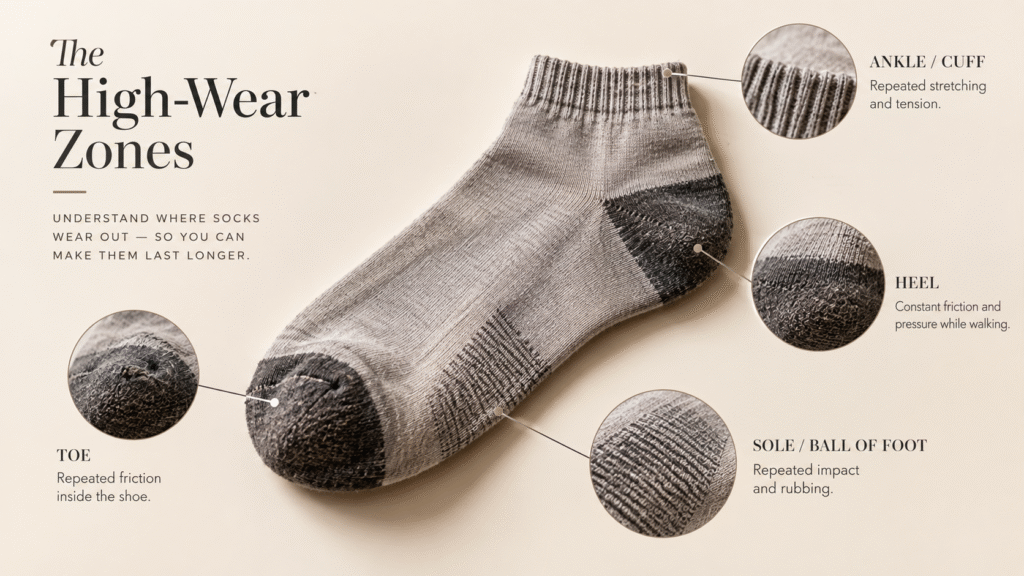
- Thinning at the heel or toe – the two areas that take the most friction with every step.
- Loss of stretch at the ankle band – if it no longer snaps back after being pulled, the elastane has given up.
- Bobbling or pilling on the sole – a sign the fibers are breaking down from repeated friction.
- Colour fading unevenly, especially on darker or printed pairs. It’s a clue that the wash routine has been too harsh.
Premium cotton socks, cared for well, should comfortably outlast the cheaper multipacks by several months, sometimes longer. If a pair from a quality brand is falling apart within weeks, that’s usually a washing or drying issue and not a quality one.

Storage Tips Nobody Talks About
Most of us just ball up socks and toss them into a drawer, but that habit stretches out the elastic at the opening over time. A better method is to fold them flat, one on top of the other, or roll them loosely without pulling the band into a tight knot.
If you live in a humid city like Mumbai which, let’s be honest, covers most of India for at least half the year then make sure socks are completely dry before storing them. Even slightly damp cotton stored in a closed drawer is an invitation for a musty smell, or worse, mildew.
Busting a Few Common Myths
Myth: All-cotton socks are always better than blends. Not quite. Pure cotton is breathable but tends to lose shape faster. A cotton-elastane blend is what most well-made premium socks use and it holds its fit far longer while still keeping the breathability that Indian weather demands.
Myth: Washing socks in hot water kills germs better, so it’s worth the damage. Cold or lukewarm water combined with a good detergent is enough to keep socks hygienic. Hot water mainly damages the fibres, not the bacteria.
Myth: If it still fits, it’s still good. Fit and fibre health aren’t the same thing. A sock can still slide onto your foot while the cushioning, breathability, and elasticity underneath have already worn thin.
The Real Secret to Longevity
Good socks aren’t meant to be disposable, and treating them a little better than “just another load of laundry” makes a real difference for both to how long they last and how comfortable they feel through a full day of commuting, working, or dressing up. A few small changes in how you wash, dry, and store them can easily add months, sometimes years, to a good pair’s life.
At the end of the day, it’s the same principle that applies to most things worth keeping that a little care upfront saves you from replacing it too soon.